The 4 Ways Enterprises Connect to the Cloud — And Why Diagnosing Each One Requires a Different Playbook
February 2026 · 5 min read
Enterprise cloud connectivity follows four distinct patterns — each with its own failure modes and diagnostic requirements. BGP hijacking, VPN saturation, multi-layer interconnect failures, and subsea cable maintenance all require different playbooks.
Yet most tools treat connectivity as a single problem. They ping endpoints. They don't understand the relationship between an Equinix virtual circuit and an AWS Direct Connect VIF, or correlate local BGP flaps with transatlantic cable maintenance.
That gap is why we built Circuit Breaker. Here's how the four patterns break — and what to check in each.
THE 4 CONNECTIVITY PATTERNS (AND WHAT BREAKS IN EACH)
Pattern 1: Transfer Over the Internet
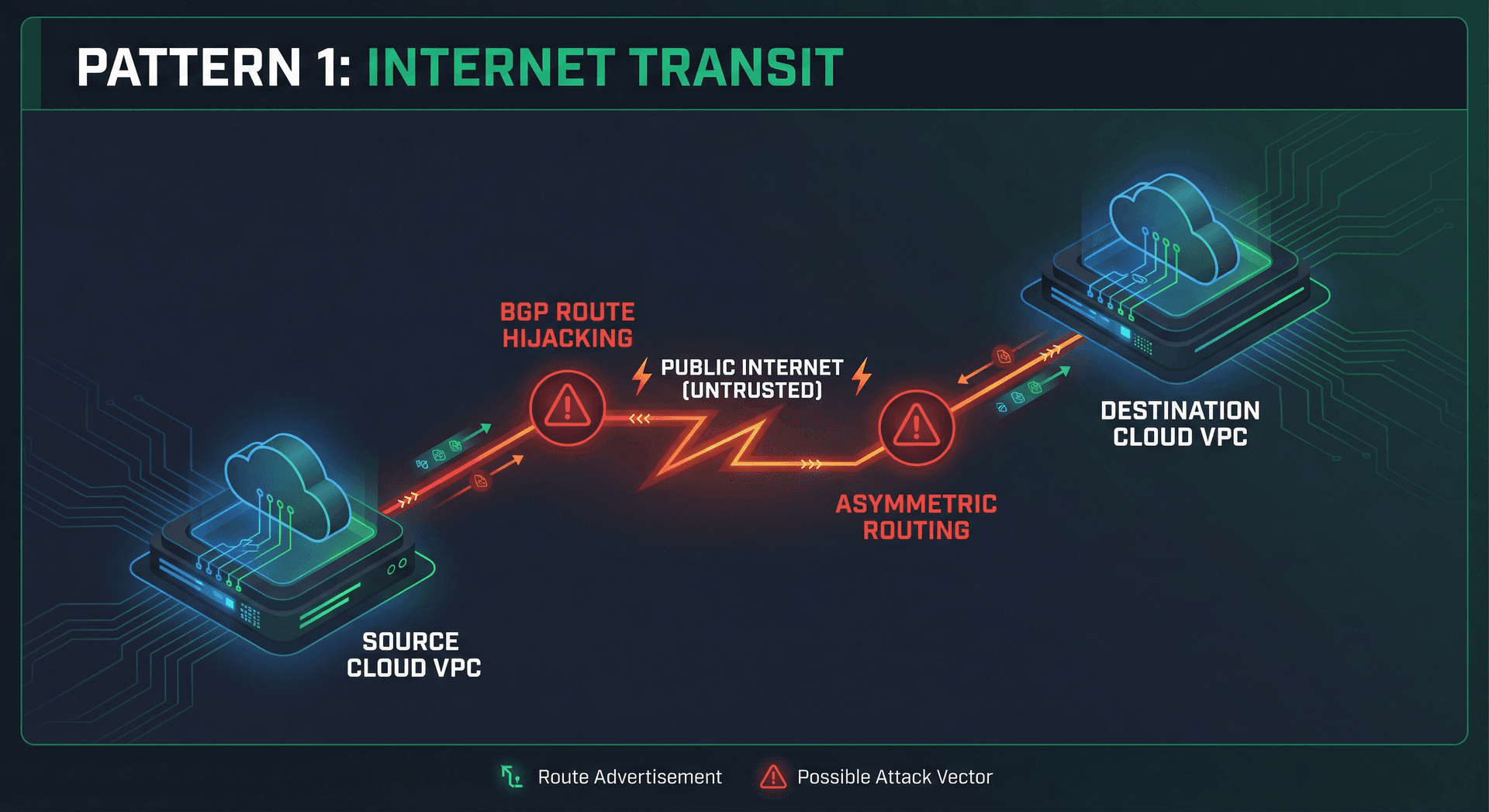
The simplest pattern. Your on-prem server or cloud VPC talks to another cloud provider via their public IPs. No special hardware. Firewall rules, maybe a VPN tunnel, and you're done.
What breaks here: BGP route hijacking. ISP outages. Asymmetric routing. Traffic that was flowing fine yesterday suddenly taking an unexpected path through a foreign AS and arriving corrupted — or not at all.
When your Azure-hosted app stops talking to your AWS data lake at 2 AM, the first question is: is this a BGP problem, a DNS problem, or a firewall problem? Without tools, you're running traceroutes and calling ISPs.
Diagnosis time manually: 30–60 minutes.
Pattern 2: Managed VPN Between Cloud Providers
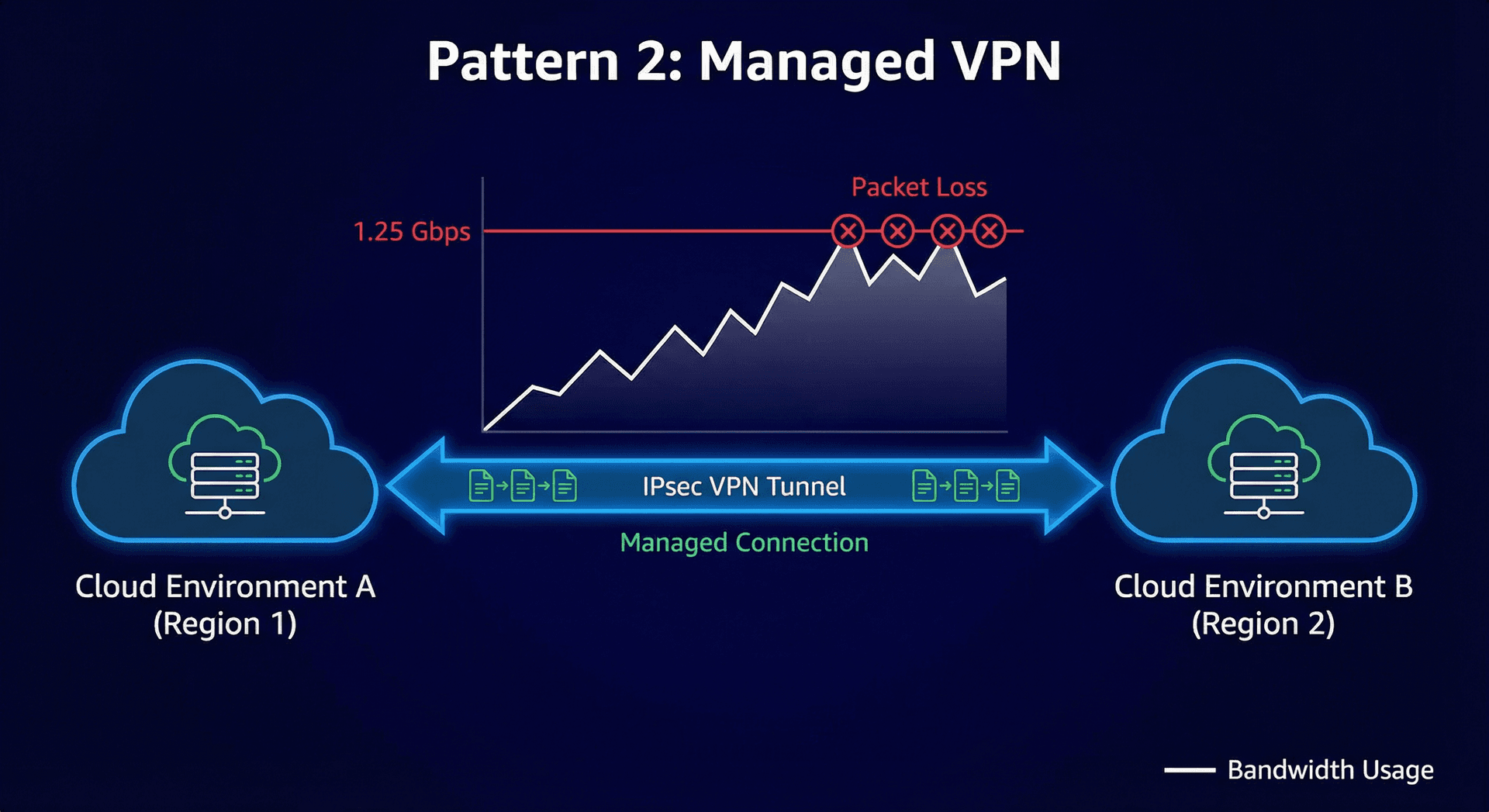
Step up from raw internet. You provision a VPN Gateway in AWS and Azure, create an IPsec tunnel with private IP addressing, and traffic flows encrypted between your VPCs.
What breaks here: IPsec tunnel flapping. Dead Peer Detection (DPD) timeouts. Asymmetric routing where traffic goes one way but returns another. MTU mismatches that cause fragmentation issues at exactly the packet size your application uses.
The sneaky failure mode: your primary Direct Connect circuit goes down, failover kicks in to the VPN backup — and nobody notices because connectivity is restored. Until the VPN gets saturated at 1.25 Gbps and starts dropping packets during your peak batch window.
Diagnosis time manually: 1–2 hours.
Pattern 3: Dedicated Interconnect (Equinix / AWS Direct Connect / Azure ExpressRoute)
This is where 80% of enterprise cloud traffic lives, and where 90% of hard-to-diagnose outages happen.
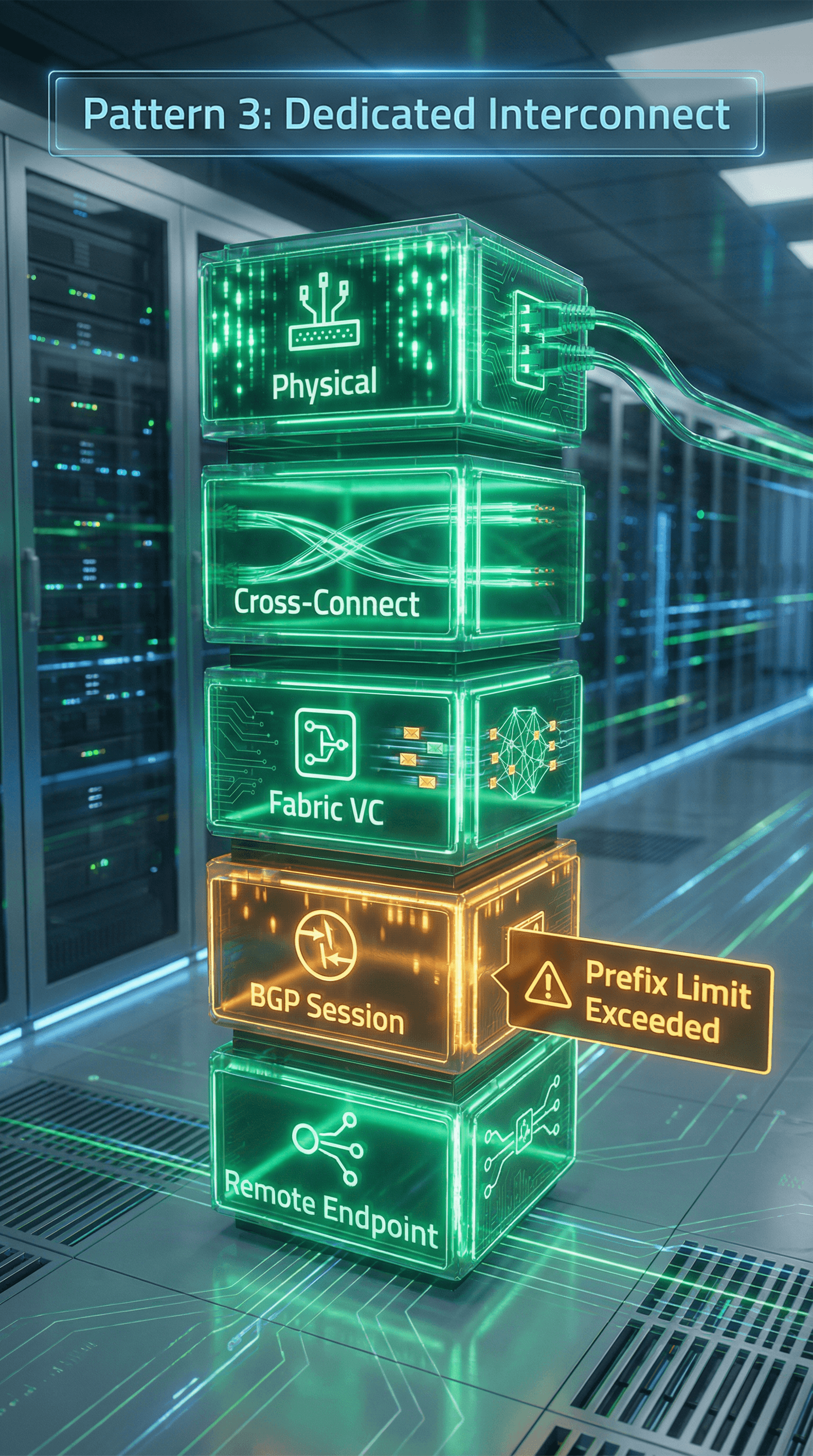
You're in an Equinix facility — DC2, DC4, or DC6 here in Ashburn. You have a physical cross-connect to a patch panel. A virtual circuit (VC) provisioned through Equinix Fabric. A BGP session to AWS at ASN 7224 or Azure at ASN 12076. And a router — Cisco or Juniper — with interfaces, optical power levels, and BGP timers you need to check.
When something breaks, the possible failure points multiply:
- Physical layer (optical power, fiber, patch panel)
- Cross-connect (LLDP neighbor mismatch)
- Equinix Fabric (virtual circuit status: ACTIVE / UNKNOWN / INACTIVE)
- BGP session (neighbor state, MD5 key, prefix limits)
- Remote endpoint (is the AWS VPC or Azure VNet actually reachable?)
A senior engineer working through these manually hits every system in sequence: SSH into the router, check interface state, check BGP summary, log into Equinix Fabric portal, check VC status, call Equinix support if needed, check AWS console, check Azure portal.
Total diagnosis time: 2–4 hours.
Circuit Breaker runs all five checks in parallel. Diagnosis time: 10–15 seconds.
Pattern 4: Subsea & Long-Haul Fiber (The Layer Nobody Talks About)
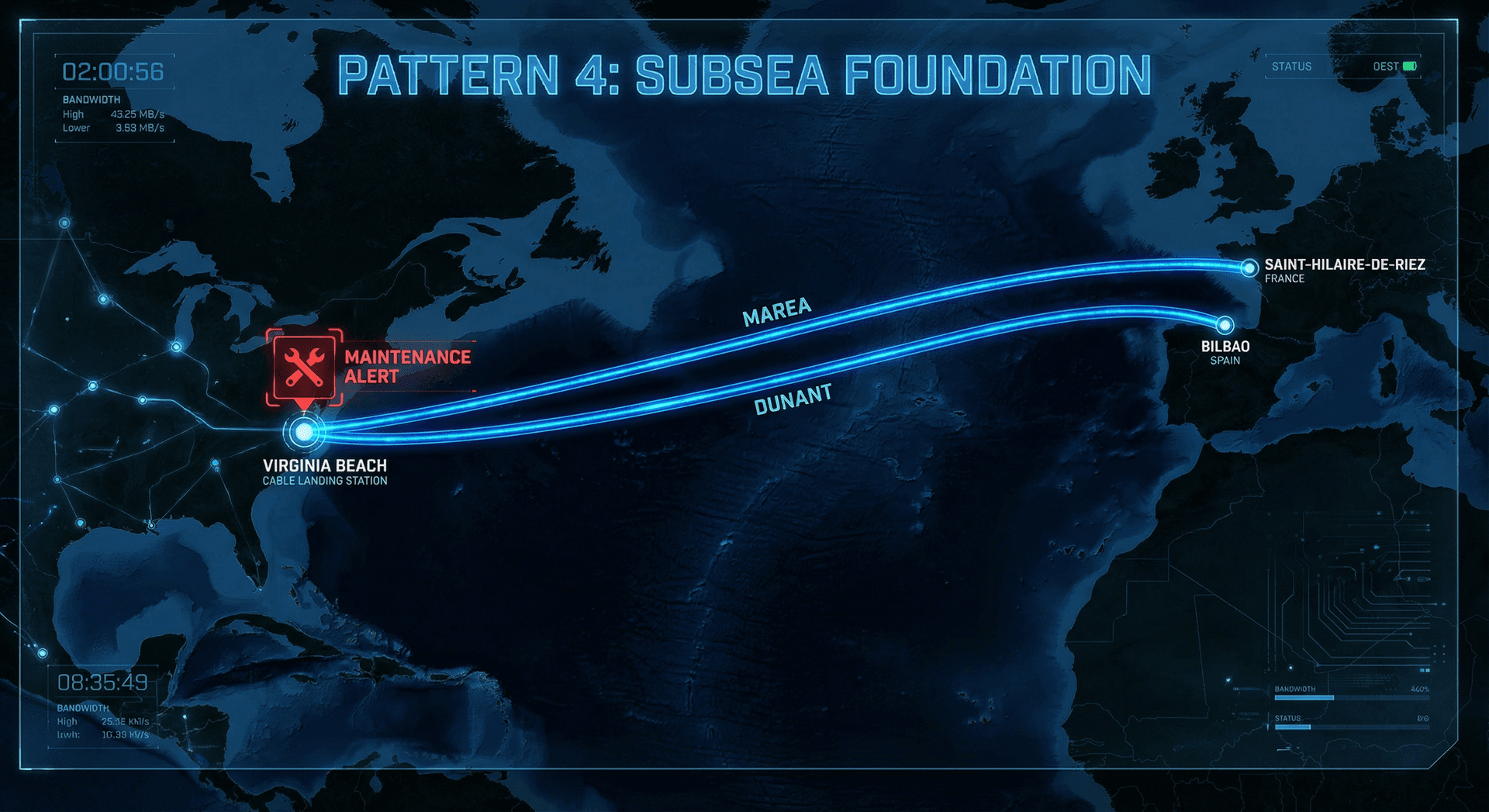
This is the foundation everything else sits on.
MAREA, one of the major transatlantic cables, carries 160 Tbps across the Atlantic from Virginia Beach to Bilbao, Spain. Dunant, also out of Virginia Beach, carries Google's transatlantic traffic. Every Azure ExpressRoute circuit connecting Ashburn to a European customer runs over one of these cables.
When MAREA had a maintenance window in 2023, Azure ExpressRoute circuits connecting US customers to European VNets showed BGP session instability — not because the customer's circuit was broken, but because Microsoft was rerouting traffic during the maintenance.
Most Data Center Operators and even most enterprise network teams don't know to check subsea cable maintenance schedules when diagnosing transatlantic connectivity issues. They spend hours troubleshooting a BGP problem that isn't actually on their circuit.
Circuit Breaker cross-references Equinix maintenance windows, subsea cable operator status pages, and Cloudflare's global BGP routing data to identify when a "local" outage is actually caused by a provider event the customer's team has no visibility into.
THE DIAGNOSTIC COVERAGE COMPARISON
| Pattern | Manual Diagnosis | Circuit Breaker | Layers Checked |
|---|---|---|---|
| Internet / BGP | 30–60 min | 5 seconds | BGP, endpoint ping |
| Managed VPN | 1–2 hours | 20 seconds | Tunnel, BGP, failover |
| Dedicated (DX/ER) | 2–4 hours | 10–15 seconds | 5 layers in parallel |
| Subsea correlation | Never diagnosed | 30 seconds | BGP + cable status |
WHY EXISTING TOOLS DON'T SOLVE THIS
The monitoring tools Data Center Operators use today — PRTG, SolarWinds, LibreNMS — were built to monitor internal networks. They ping endpoints. They check interface counters. They alert when something is down.
What they don't do: understand the relationship between an Equinix virtual circuit and an AWS Direct Connect VIF. Or know that when BGP to ASN 7224 drops, you should check the VIF state before touching the router config. Or correlate a transatlantic BGP anomaly with a subsea cable's scheduled maintenance window.
Circuit Breaker was built for multi-layer interconnect diagnostics. It encodes the reasoning that separates monitoring from diagnosis — not just "something is down," but "why is it broken and what do I do next" — turning a 4-hour war room into a 10-second check.
WHO THIS IS BUILT FOR
If you're a Data Center Operator or Smart Hands provider servicing data centers in Ashburn — DC2, DC4, DC6, DC10, DC11 — your customers are running Direct Connect and ExpressRoute circuits every day. Every hour of MTTD (Mean Time to Diagnose) on a connectivity incident is an hour your customer is down and your SLA is at risk.
We're running a Q1 2026 pilot with 5 Ashburn Data Center Operators. $1,000/month. All four agents. Cancel anytime.
If you're curious, reach out: hello@alleyagents.com or visit alleyagents.com.